
You don’t need a gym membership or expensive equipment to start getting stronger. The best beginner strength training exercises at home use basic movement patterns such as squatting, pushing, pulling, bending, and bracing. With a few simple exercises and consistent practice, you can build strength, improve movement, and establish a sustainable fitness routine from the comfort of home.
Whether you’re completely new to resistance training or returning after a long break, the key is to start gradually and focus on good technique. You can begin with your own body weight and add resistance later with dumbbells, resistance bands, or household equipment designed for exercise.
This guide covers the best beginner exercises, how to perform them, how many sets and repetitions to start with, and how to create a simple full-body home workout.
What Is Strength Training?
Strength training is exercise that makes your muscles work against resistance.
That resistance can come from:
- Your body weight
- Dumbbells
- Resistance bands
- Kettlebells
- Weight machines
- Barbells
- Other appropriate resistance equipment
You don’t need heavy weights to begin.
For beginners, bodyweight exercises can provide an effective introduction to resistance training while helping you learn basic movement patterns.
Strength training can complement cardiovascular exercise and provide benefits for muscle strength, physical function, and overall fitness.
Benefits of Strength Training at Home
A consistent strength-training routine can help you:
- Build and maintain muscle
- Improve muscular strength
- Support healthy bones
- Improve balance and coordination
- Make everyday activities easier
- Support physical function as you age
- Increase confidence with movement
- Develop a consistent exercise habit
The goal isn’t to exhaust yourself every workout.
Consistency matters more than complexity.
12 Best Beginner Strength Training Exercises at Home
These exercises cover many of the major movement patterns needed for a simple full-body routine.
1. Bodyweight Squat
The bodyweight squat is one of the best exercises for beginners.
It primarily works the:
- Quadriceps
- Glutes
- Hamstrings
- Core
How to Do a Bodyweight Squat
- Stand with your feet around shoulder-width apart.
- Keep your chest comfortably upright.
- Brace your core.
- Bend your knees and push your hips backward.
- Lower yourself as far as you can comfortably control.
- Keep your feet firmly planted.
- Push through your feet to return to standing.
Beginner Starting Point
2–3 sets of 8–12 repetitions
If a full squat is difficult, squat to a sturdy chair and use it as a depth target.
2. Wall Push-Up
Push-ups are excellent for developing upper-body strength, but a traditional floor push-up can be challenging for beginners.
A wall push-up provides an easier starting point.
It works your:
- Chest
- Shoulders
- Triceps
- Core
How to Do It
- Stand facing a wall.
- Place your hands against the wall slightly wider than shoulder-width.
- Step your feet backward.
- Keep your body in a straight line.
- Bend your elbows and bring your chest toward the wall.
- Push yourself back.
Progression
Once wall push-ups become easy, move to:
Countertop push-ups → bench/incline push-ups → knee push-ups → full push-ups
3. Glute Bridge
The glute bridge is a simple way to strengthen your posterior chain.
It primarily targets:
- Glutes
- Hamstrings
- Core
How to Do It
- Lie on your back.
- Bend your knees.
- Place your feet flat on the floor.
- Keep your arms beside your body.
- Brace your core.
- Press through your feet.
- Lift your hips.
- Pause briefly at the top.
- Lower with control.
Beginner Starting Point
2–3 sets of 10–15 repetitions
Avoid simply arching your lower back to lift your hips.
Focus on using your glutes.
4. Reverse Lunge
Lunges train your legs individually, which can help develop strength and balance.
They target:
- Quadriceps
- Glutes
- Hamstrings
How to Do It
- Stand upright.
- Step one foot backward.
- Lower your body under control.
- Keep your front foot stable.
- Push through your front foot to return to standing.
- Repeat on the opposite side.
If balance is difficult, hold onto a sturdy support.
Beginner Starting Point
2 sets of 6–10 repetitions per side
5. Step-Up
If you have a stable, exercise-appropriate step or platform, step-ups are an effective beginner leg exercise.
They work the:
- Quadriceps
- Glutes
- Hamstrings
How to Do It
- Stand in front of a stable platform.
- Place one foot firmly on it.
- Push through that foot.
- Bring the other foot up.
- Step down under control.
- Alternate sides.
Never use an unstable chair or surface for this exercise.
6. Bird Dog
The bird dog helps train core stability while challenging coordination.
It works the:
- Core
- Back
- Glutes
- Shoulders
How to Do It
- Start on your hands and knees.
- Keep your spine neutral.
- Brace your core.
- Extend one arm and the opposite leg.
- Pause briefly.
- Return to the starting position.
- Switch sides.
Beginner Starting Point
2–3 sets of 6–10 repetitions per side
Move slowly rather than trying to complete repetitions quickly.
7. Dead Bug
The dead bug is another beginner-friendly core exercise.
How to Do It
- Lie on your back.
- Raise your arms toward the ceiling.
- Bring your knees up.
- Brace your abdominal muscles.
- Slowly extend one arm and the opposite leg.
- Return to the starting position.
- Repeat on the opposite side.
The goal is to maintain control rather than move as far as possible.
Beginner Starting Point
2–3 sets of 6–10 repetitions per side
8. Hip Hinge
Learning the hip hinge is important because it teaches you how to bend from the hips rather than repeatedly rounding your lower back.
It prepares you for exercises such as:
- Deadlifts
- Romanian deadlifts
- Kettlebell movements
How to Practice
- Stand with your feet comfortably apart.
- Keep your spine neutral.
- Slightly bend your knees.
- Push your hips backward.
- Keep your torso controlled.
- Return to standing by driving your hips forward.
Practice this movement without weight until it feels natural.
9. Resistance-Band Row
If you have a resistance band, rows provide an important pulling movement that bodyweight-only beginners may otherwise struggle to train.
They target:
- Upper back
- Rear shoulders
- Biceps
How to Do It
- Secure the band according to the manufacturer’s instructions.
- Hold the handles or band.
- Keep your chest comfortably upright.
- Pull your elbows backward.
- Squeeze your shoulder blades gently.
- Return slowly.
Never attach a resistance band to an object that isn’t designed or securely positioned for exercise.
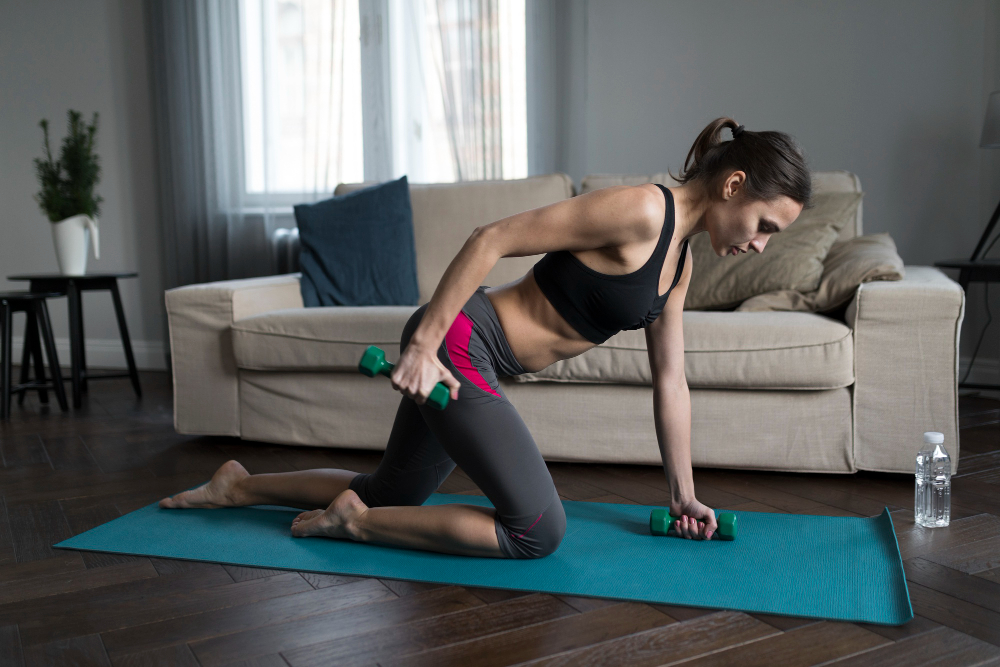
10. Dumbbell Row
If you own dumbbells, the one-arm dumbbell row is another excellent beginner pulling exercise.
How to Do It
- Place one hand on a stable exercise bench or other appropriate support.
- Hold a dumbbell in the opposite hand.
- Keep your back controlled.
- Pull the dumbbell toward your hip.
- Lower it slowly.
- Repeat.
Use a manageable weight and prioritize technique.
11. Dumbbell Shoulder Press
With appropriate dumbbells, the shoulder press trains the:
- Shoulders
- Triceps
- Upper body
How to Do It
- Sit or stand with good posture.
- Hold the weights around shoulder level.
- Brace your core.
- Press the weights upward.
- Lower them slowly.
Start with light resistance while learning the movement.
12. Calf Raises
Calf raises are simple and require very little space.
How to Do Them
- Stand with your feet comfortably apart.
- Hold onto a stable support if needed.
- Rise onto the balls of your feet.
- Pause briefly.
- Lower your heels slowly.
Beginner Starting Point
2–3 sets of 12–20 repetitions
Beginner Strength Training Workout at Home
You don’t need to perform all 12 exercises in one session.
Start with a manageable full-body routine.
Beginner Workout A
1. Bodyweight Squat
2–3 sets × 8–12 reps
2. Wall or Incline Push-Up
2–3 sets × 8–12 reps
3. Glute Bridge
2–3 sets × 10–15 reps
4. Bird Dog
2–3 sets × 6–10 reps per side
5. Reverse Lunge
2 sets × 6–10 reps per side
6. Resistance-Band or Dumbbell Row
2–3 sets × 8–12 reps
Rest between sets as needed.
The goal is to finish the workout feeling that you could have done a little more—not completely exhausted.
How Many Days a Week Should Beginners Strength Train?
For beginners, two or three strength-training sessions per week can be a practical starting point.
Avoid thinking that you need to train every day to make progress.
Your muscles need time to recover.
A simple schedule might look like:
Monday: Full-body strength
Tuesday: Walking or rest
Wednesday: Full-body strength
Thursday: Rest or light activity
Friday: Full-body strength
Weekend: Walking, recreational activity, or rest
If three sessions feel like too much initially, start with two.
How Many Repetitions Should Beginners Do?
There isn’t one perfect repetition range for everyone.
A practical starting point for many exercises is:
8–12 controlled repetitions per set
For easier bodyweight exercises, you may comfortably perform more repetitions.
For challenging exercises, fewer repetitions may be appropriate.
The most important factors are:
- Good technique
- Appropriate resistance
- Consistency
- Gradual progression
How Many Sets Should Beginners Do?
Start with approximately 2 sets per exercise.
As you become more comfortable, you can gradually increase to three sets.
You don’t need a huge volume of exercise to begin making progress.
A short routine performed consistently is better than an ambitious program that you abandon after two weeks.
How Long Should a Beginner Home Workout Last?
A beginner strength workout can often fit into 20–45 minutes.
Your workout might include:
- 5–10 minutes of warm-up
- 20–30 minutes of strength exercises
- A few minutes of easy movement afterward
You don’t need to spend 90 minutes exercising to benefit from strength training.
How to Warm Up Before Strength Training
A warm-up prepares you mentally and physically for exercise.
Keep it simple.
Try 5–10 minutes of:
- Walking
- Marching in place
- Arm circles
- Gentle bodyweight squats
- Hip movements
- Light versions of your planned exercises
The warm-up should gradually increase movement and body temperature without exhausting you.
How to Progress Your Home Strength Workout
Progressive overload means gradually increasing the challenge placed on your muscles.
You can progress by:
Increasing Repetitions
Example:
8 reps → 10 reps → 12 reps
Increasing Resistance
Move from bodyweight to resistance bands or dumbbells.
Adding a Set
2 sets → 3 sets
Improving Range of Motion
Perform the movement through a comfortable, controlled range.
Improving Technique
Better control can make an exercise more challenging without adding weight.
Increasing Exercise Difficulty
For example:
Wall push-up → incline push-up → floor push-up
Progress gradually rather than trying to jump straight to advanced variations.
Beginner Strength Training Without Equipment
You can create a useful routine using only your body weight.
Try:
- Squats
- Reverse lunges
- Glute bridges
- Wall push-ups
- Incline push-ups
- Bird dogs
- Dead bugs
- Calf raises
The biggest challenge with equipment-free training is pulling exercises.
If possible, adding a resistance band can make your home program more balanced by giving you a practical way to train your back.
How to Make Bodyweight Exercises Harder
You don’t necessarily need heavier weights to increase the challenge.
Try:
- Slowing down the lowering phase
- Pausing at difficult points
- Increasing repetitions
- Using single-leg variations
- Increasing range of motion
- Moving to a harder variation
For example:
Bodyweight squat → pause squat → split squat → assisted single-leg squat
Only progress when you can perform the easier version with good control.
Common Beginner Strength Training Mistakes
Mistake 1: Doing Too Much Too Soon
Trying to exercise six or seven days per week can lead to excessive soreness and make consistency difficult.
Start gradually.
Mistake 2: Chasing Soreness
Muscle soreness is not the same thing as progress.
A good workout doesn’t have to leave you unable to walk the next day.
Mistake 3: Ignoring Technique
Adding repetitions or resistance while sacrificing form can reduce the quality of the exercise and increase injury risk.
Mistake 4: Never Progressing
If the same exercise remains equally easy for months, your body may have little reason to adapt further.
Gradually increase the challenge.
Mistake 5: Training Only Visible Muscles
Don’t focus exclusively on chest, arms, or abs.
Train the whole body.
Include:
- Squatting
- Pushing
- Pulling
- Hip hinging
- Core stabilization
- Single-leg movements
How to Create a Balanced Full-Body Workout
A simple full-body program should cover several movement patterns.
| Movement | Beginner Exercise |
|---|---|
| Squat | Bodyweight squat |
| Push | Wall/incline push-up |
| Pull | Resistance-band row |
| Hip extension | Glute bridge |
| Single-leg | Reverse lunge |
| Core stability | Bird dog |
| Calves | Calf raise |
This gives you a foundation without requiring dozens of exercises.
Strength Training and Cardio: Do You Need Both?
Strength training and cardiovascular activity serve different purposes, and combining them can create a well-rounded fitness routine.
Cardio activities can include:
- Walking
- Cycling
- Swimming
- Jogging
- Dancing
You don’t have to choose between strength training and cardio.
A weekly routine can include both.
For general health, adults are commonly advised to include both aerobic activity and muscle-strengthening activity as part of their overall physical activity routine.
Do You Need Equipment for Home Strength Training?
No.
You can start with bodyweight exercises.
However, basic equipment can expand your options.
Useful additions include:
- Resistance bands
- Adjustable dumbbells
- Exercise mat
- Stable exercise bench
- Appropriate step platform
You don’t need to buy everything at once.
A resistance band and a pair of adjustable dumbbells can significantly expand the number of exercises available.
How Beginners Can Stay Consistent
The biggest challenge isn’t finding exercises.
It’s sticking with them.
Try these strategies:
Schedule Your Workouts
Treat exercise like an appointment.
Keep Workouts Short
A 25-minute workout is better than a two-hour workout you never complete.
Track Your Progress
Record:
- Exercise
- Repetitions
- Sets
- Resistance
- Date
Start Easier Than You Think
Leave room to progress.
Focus on Habit First
Don’t worry about achieving advanced fitness immediately.
Your first goal is consistency.
Frequently Asked Questions
What are the best strength training exercises for beginners at home?
Bodyweight squats, wall or incline push-ups, glute bridges, reverse lunges, bird dogs, dead bugs, calf raises, and resistance-band rows are excellent beginner options.
Can I build strength without going to the gym?
Yes. Beginners can build strength using bodyweight exercises and progressively more challenging movements. Resistance bands and dumbbells can provide additional options as you progress.
How often should a beginner do strength training?
Two or three full-body strength sessions per week can be a practical starting point for many beginners. Allow adequate recovery between sessions.
How long should a beginner strength workout last?
Around 20–45 minutes can be sufficient for a beginner. Workout quality and consistency are more important than spending a long time exercising.
Can I strength train every day?
You don’t need to strength train the same muscles every day. Beginners generally benefit from allowing recovery between challenging full-body sessions.
Is bodyweight training enough for beginners?
Yes. Bodyweight training can provide an effective starting point. As exercises become easy, increase the difficulty or add resistance.
How quickly can I see results from strength training?
Progress varies from person to person. Beginners may notice improvements in coordination and strength relatively early, while visible changes in muscle size or body composition generally require more time and consistent training.
Should I work out if my muscles are sore?
Mild soreness does not necessarily mean you must stop all activity, but severe soreness or pain is a reason to reduce intensity and allow more recovery. Avoid training through sharp or unusual pain.
Can strength training help with weight management?
Strength training can contribute to an active lifestyle and help maintain or build muscle. For changes in body weight, overall energy intake and expenditure also matter.
Safety Tips for Beginner Strength Training
Before starting a new exercise program, consider your current fitness level and any limitations you may have.
Keep these principles in mind:
- Start with manageable resistance.
- Learn the movement before adding weight.
- Use controlled repetitions.
- Keep your exercise area clear.
- Use stable equipment.
- Stop if you experience sharp or unusual pain.
- Don’t hold your breath unnecessarily.
- Give your body adequate recovery time.
If you have an existing medical condition, recent injury, significant pain, or concerns about whether exercise is appropriate for you, speak with a qualified healthcare professional before beginning a new training program.
A Simple 4-Week Beginner Progression
You can use this structure to gradually build your routine.
Week 1
Perform 2 workouts.
Focus on learning technique.
Week 2
Perform 2–3 workouts.
Try to add a few repetitions where appropriate.
Week 3
Maintain 2–3 workouts.
Increase resistance or move toward a slightly harder exercise variation.
Week 4
Continue progressing gradually.
Consider adding a third set to selected exercises if recovery is good.
You don’t need to increase everything simultaneously.
Change one variable at a time.
The Bottom Line
The best beginner strength training exercises at home are simple movements that train your entire body without requiring complicated equipment.
Start with:
- Squats for your legs
- Push-ups for your upper body
- Glute bridges for your hips
- Lunges for single-leg strength
- Rows for pulling strength
- Bird dogs and dead bugs for core stability
- Calf raises for your lower legs
Aim for two or three sessions per week, start with manageable sets and repetitions, and gradually increase the challenge as your strength improves.
You don’t need to destroy yourself during every workout. You need a routine that you can repeat week after week.